Wealth managers gain advantage by connecting relevant, varied content, intuitive digital experiences, and sustained multichannel engagement into educational ecosystems.
Read time: 5 minutes.
09/04/2026
Market signals: The education ecosystem

Executive summary
Increasingly important is not just the frequency or volume of thought leadership and educational content published, but how it is deployed as an asset to develop the foundations of the client relationship. Wealth managers increasingly understand what to publish, but fewer combine sufficient format breadth with the digital experience needed to turn content into an engaging educational system.
Few firms engage fully with a range of available social platforms, leaving a missed opportunity to develop a breadth of brand touchpoints. Broadly, the firms that connect content, experience and continuity of engagement into a sophisticated ecosystem are able to gain a clear competitive advantage – building familiarity, credibility and authority of voice across the digital landscape.
Building client trust through the educational ecosystem
In a digital era of Wealth Management, the first encounter potential clients have with a firm is increasingly likely to happen inside of the information ecosystem through which they move every day.
Across a daily flow of articles, alerts, newsletters, podcasts and social feeds, firms have an opportunity to move beyond simply publishing expertise and begin using it to establish the foundations of the client relationship.
Done well, these repeated interactions can build familiarity, authority and trust long before an advisor or relationship manager enters the picture.
Capitalizing on that opportunity, however, requires more than producing content. Firms need to build a fleshed-out and cohesive educational ecosystem: one that brings together relevant ideas, varied formats, intuitive digital experiences and consistent opportunities for audiences to discover, explore and return.
Once firms fully consider the content, experience and continuity of their educational network, they grant themselves a critical competitive edge.

Content – a reason to tune in
Any effective thought-leadership ecosystem starts with substance. Content must address the issues occupying clients, offer a clear perspective and translate institutional expertise into guidance that is timely, relevant and useful. On this front, wealth managers show encouraging signs.
Our Living Ratings research reveals that across core social channels, 94% of firms take a client-first, issue-led approach to publishing, suggesting that most understand the importance of organizing thought leadership around audience concerns rather than corporate activity alone.
The greater weakness lies in the depth and richness of the content itself. A mature educational proposition can extend beyond a steady stream of written commentary, drawing on a broader mix of editorial formats to develop ideas in greater depth and bring specialist knowledge to life.
Content format usage
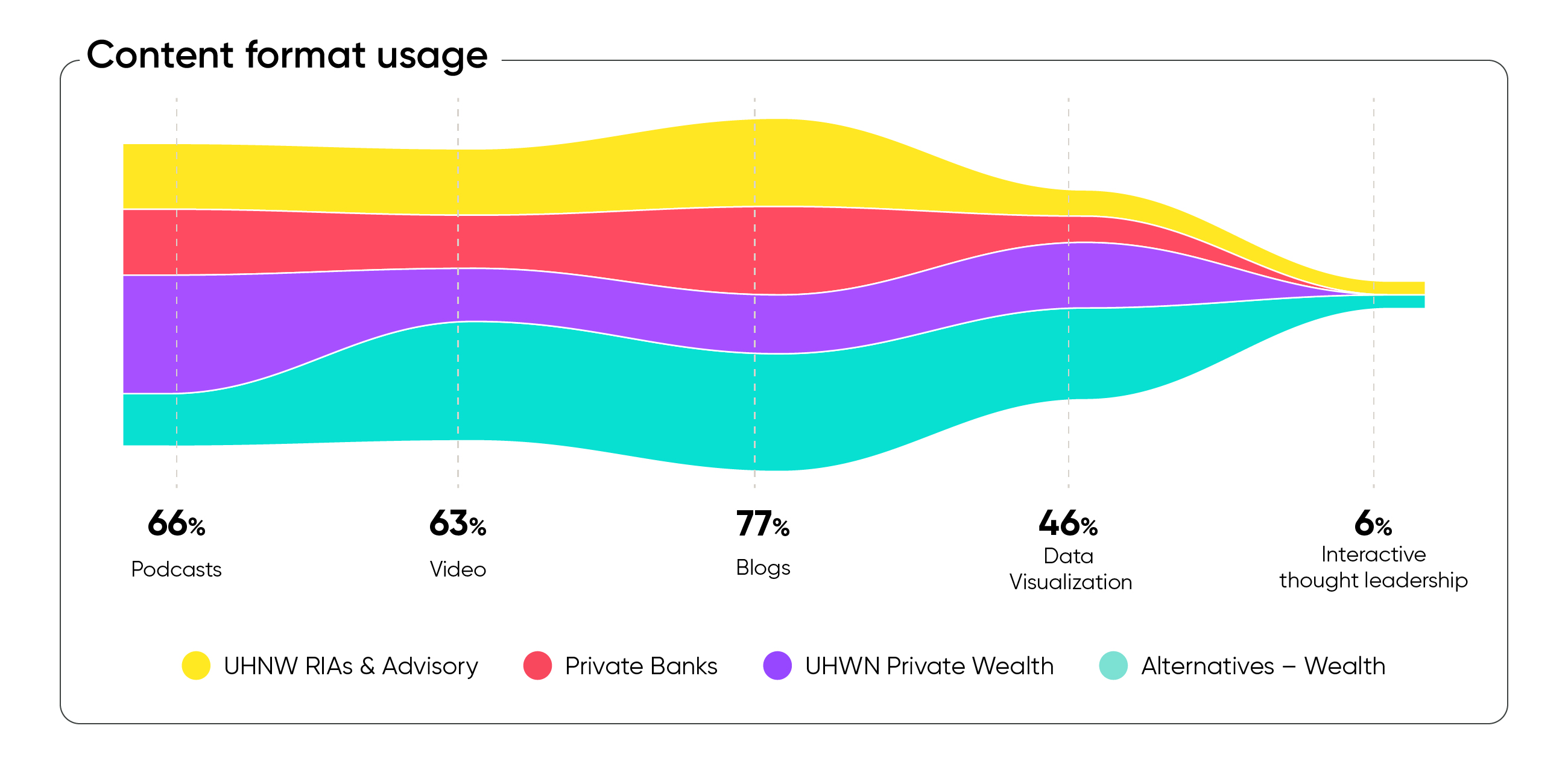
Audio is a relative strength, with 66% of firms offering podcast content. Video is more widespread still: 97% of firms use video or webinars somewhere within the experience, although only 63% do so consistently enough to reach full marks.
Written publishing presents a similar distinction between presence and depth. 77% of firms receive at least some marks for regular publication of content, but only 34% reach full marks for a dedicated, editorial and consistently developed blog series.
More sophisticated formats remain considerably less common. 46% of firms make strong use of infographics and data visualization, while just 6% reach full marks for hosting interactive thought leadership.
The research reveals that content is becoming more client-led and increasingly varied, but relatively few firms are combining relevance, depth and format breadth into a genuinely substantial educational proposition.
The signal: Mind the gap
Wealth managers increasingly understand what they should be talking about. The gap lies in the breadth of formats used to develop those themes editorially.
Issue-led publishing is now widespread, and established formats such as video, podcasts and written insights are firmly embedded across much of the sector. But comparatively few firms are extending this into a broader mix of visual, participatory and interactive content capable of turning a publishing program into a more substantial educational proposition.
Experience – a way to engage
Topic-driven discovery, multimedia content and visual or participatory modes of thought leadership give potential clients a reason to tune in. The next test is whether the digital experience helps them find, navigate and pursue what interests them.
The Living Ratings data points to uneven progress. 80% of firms reach full marks for clear page taxonomy, while 83% enable users to share content through social channels, suggesting that the foundations for organization and circulation are widely established.
Turning insights into intuitive experiences
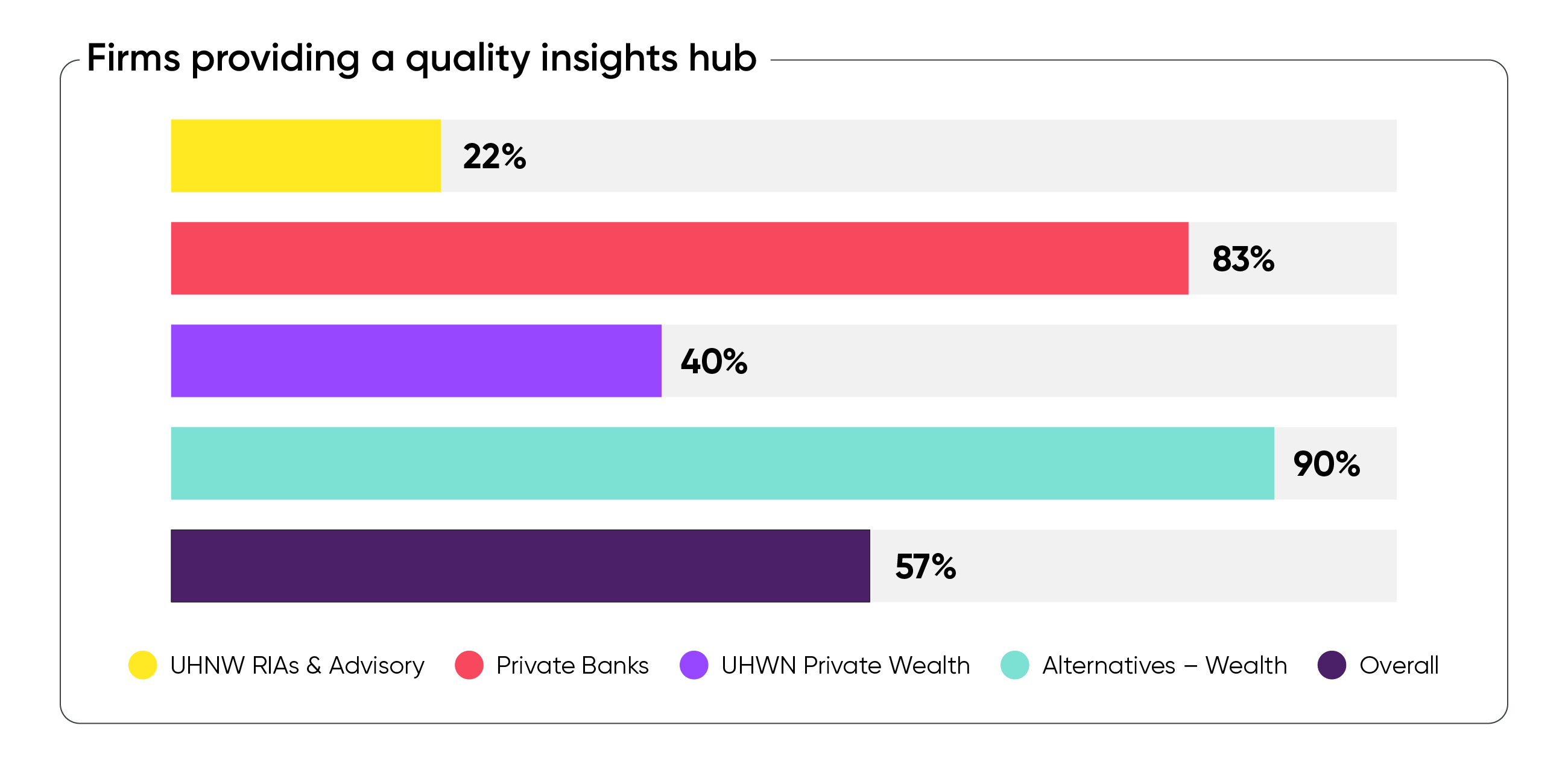
However, only 57% of firms reach full marks for their insights landing pages, meaning 43% of firms miss out on building a user-centric hub to navigate guidance and expertise.
An effective insights hub should do more than gather publications in one place. Clear content hierarchy, content filtering mechanisms, sophisticated use of imagery, effective search functionality and consistent signposting all help users make sense of the material and move through it with purpose. Together, these elements determine whether thought leadership operates as a static repository or as a coherent, intuitive and navigable experience.
The wider digital journey is less consistent still. Only 40% of firms deliver a sufficiently fluid and intuitive site experience to reach full marks for UX, while just 11% provide search functionality of the highest quality.
The signal: Connecting content to discovery
Firms are beginning to tighten their digital structures, but few are investing sufficiently in user experience design to create a coherent, enjoyable and client-centric educational platform.
Developed content strategies may bring audiences through the door, but connecting that content to a wider experience that encourages discovery and deeper exploration remains the crucial next step.
Continuity. A reason to stay connected
With content and experience addressed, the final layer of an effective thought leadership system is continuity – the mechanisms through which one interaction can develop into a longer relationship.
Potential clients rarely encounter a firm through a single, uninterrupted website journey. They move between professional networks, social feeds, video platforms, email, apps and search – forming impressions through repeated encounters with the firm’s ideas and expertise.
Subscription routes offer a direct mechanism for continuity. However, while 69% of firms provide newsletter sign-ups through their website, only 23% of firms offer a LinkedIn newsletter subscription.
More crucially for engagement continuity, is full deployment of all available social platforms.
Presence is not participation
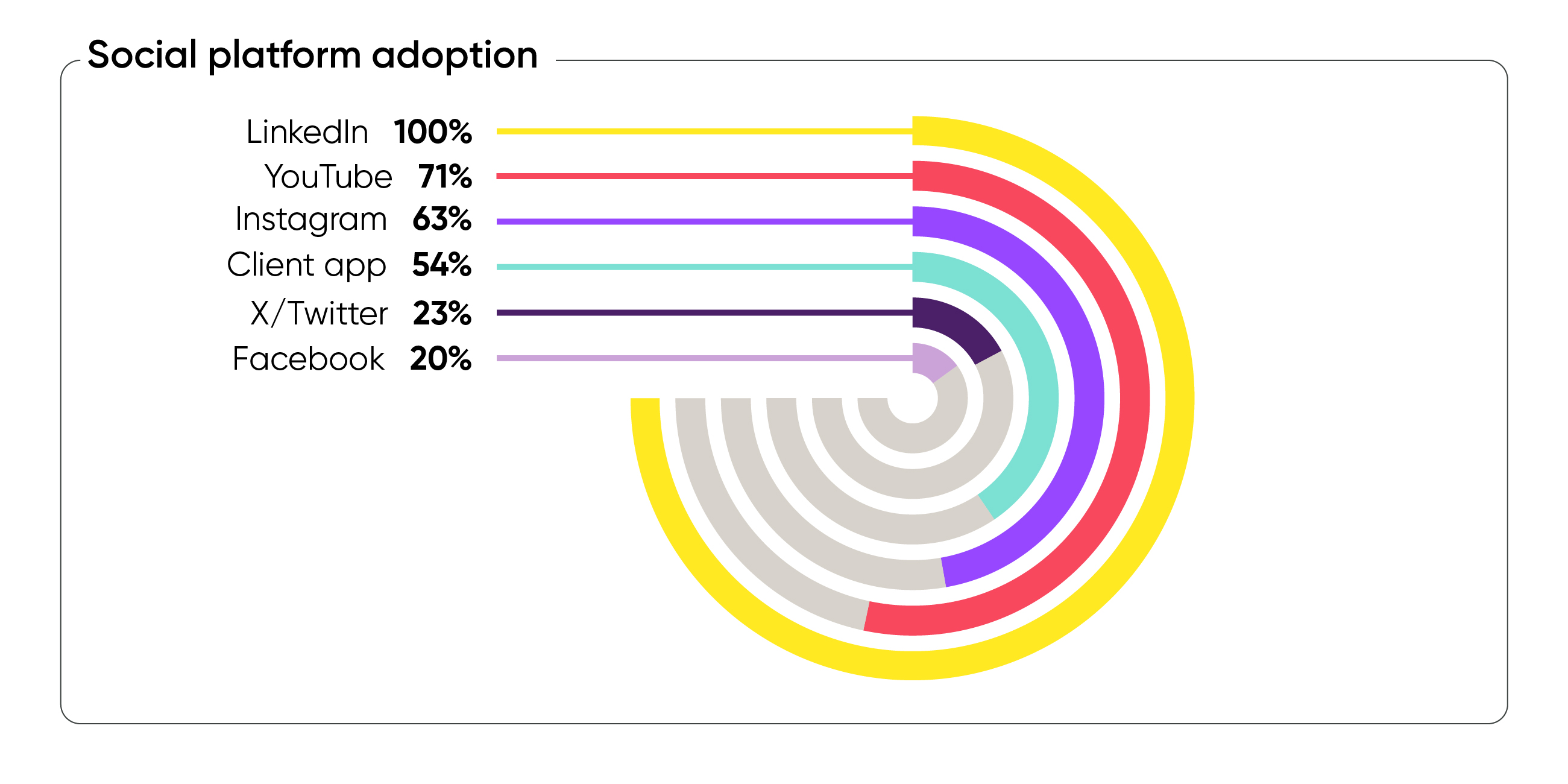
Our Living Ratings research reveals that LinkedIn remains dominant, with all firms maintaining an active presence. However, only 26% make full use of the channel’s functionality using video content and Life pages to build a richer, more developed presence.
YouTube presence is also well established, with 71% of firms maintaining an active, dedicated channel. Instagram has similarly broad adoption, with 63% of firms active on the platform. However, only 20% use Stories and Highlights to create a more dynamic channel experience.
Just 23% of firms operate an active X/Twitter account, while only 20% maintain a Facebook presence.
Beyond social media, 54% of firms offer an intermediary or client-facing app, extending the relationship through a persistent digital presence that brings together financial monitoring, insights and market updates.
The signal: The wealth transfer demands greater empathy
Wealth Management firms show strong foundations when it comes to adopting the multitude of social channels at their disposal, but adoption remains uneven.
Firms that master both channel breadth and depth can capitalize on repeated points of contact, turning occasional encounters into sustained engagement.
The next opportunity is to connect these touchpoints more deliberately, giving audiences clear reasons to subscribe, follow, return and deepen their relationship with the firm over time.
Why this matters
Clients increasingly form judgments about a firm’s relevance and credibility before direct contact. Relevant ideas earn attention, but the formats through which they are delivered determine how accessible, memorable and engaging that expertise becomes.
However, even a well-organized content experience can remain transactional: a user arrives, reads and leaves. Accessibility and intuitive navigation go beyond good user experience – they humanize the brand and demonstrate, in practice, a philosophy that places the client at the center of the experience.
Lastly, each social channel offers a distinct opportunity to reach different audiences, explore different topics and build familiarity in new contexts. A cohesive educational ecosystem requires something worth engaging with, an experience that makes engagement possible and sufficient reach to become part of the audience’s everyday information environment.
Most firms deliver one or two of these elements; few connect all three and turn isolated encounters into familiarity, trust and preference over time.

Conclusion
The opportunity now is to move from individual content initiatives and channels to a deliberately connected educational proposition. Formats, website journeys and social platforms should operate as parts of one system, guiding audiences from initial discovery toward deeper exploration and, ultimately, future conversation.
Designed in this way, thought leadership becomes a relationship-building asset rather than simply a publishing output. The leaders will not be those producing the greatest volume of content or maintaining the most channels, but those using each touchpoint to reinforce a coherent and recognizable point of view.
In doing so, they can occupy a greater share of attention and shape expectations across the market.
Want to know more?
Connect with one of our specialists: Kate Shaw in New York, Greg Hobden in London or Aliena Lai in Hong Kong.


Our latest insights, directly to your inbox