In a city where everyone is searching for the next best thing, what can a line outside a café tell us about how we recognize quality, assign value, and decide what deserves our attention?
10/20/2026
Intern in the city: New York wants to queue
What’s in a line?
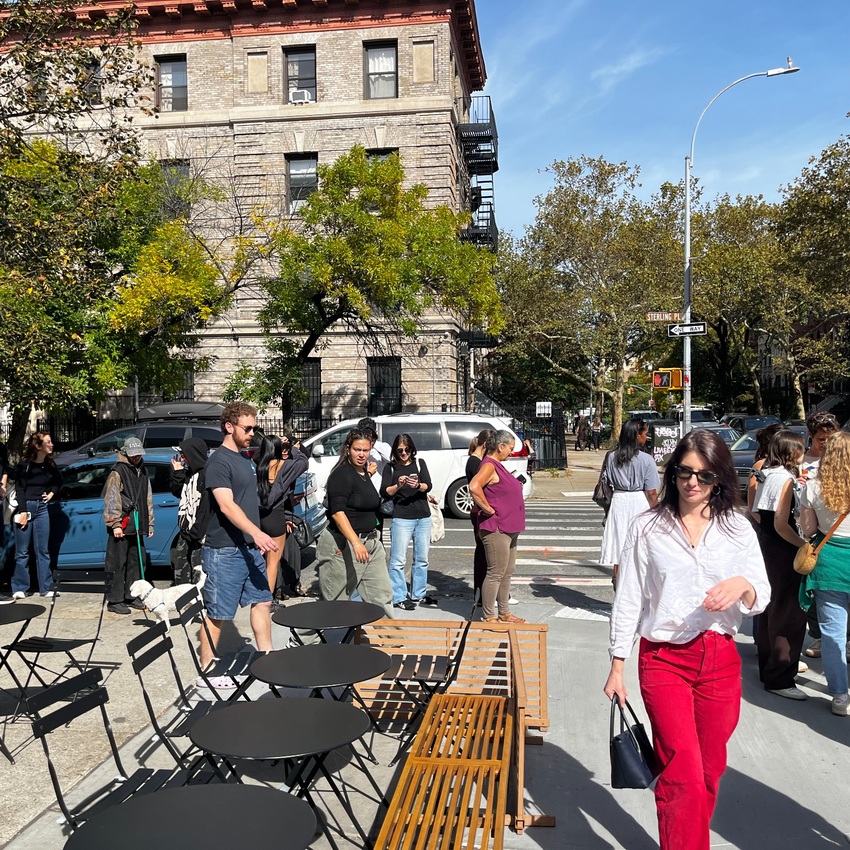
This weekend I dog-sat for a friend of mine in Prospect Heights. I like the neighbourhood, its pretty well located within Brooklyn, with just enough bars to give it a Thursday night buzz. On Saturday morning I walked from Fort Greene Park towards the eastern edge of Bed-Stuy. Along the way, I saw not one, two or three, but four queues snaking around the blocks of matcha cafes, coffee shops and dessert stores.
A pretty familiar sight in any neighborhood recently described as “up and coming,” and one I’ve never really understood.
Despite being a city of near a million options, New York loves to queue. The queue – sorry, the line – has become a sort of comical cornerstone of the city’s ‘gentrificatory’ landscape. So much so, that on my walk through Brooklyn that morning, in between wrapping black doggie bags up in neat little bows, I began to think through this cultural fixation with ‘The Queue.’
The signifier and the signified
I initially concluded that the queue acts primarily as a signifier of quality. It communicates to the social world what is - or is not - allegedly worth our time. In this sense, it performs something akin to a vital public service. It signals to passersby which restaurants, cafés or bars might satisfy basic needs for sustenance, shelter or comfort. Beyond this, it communicates what is culturally worth our attention: what seems ‘hot’, what is trending, and where we should invest whatever cultural or economic capital we have at our disposal.
In other cities, queues outside trendy spots signal that same sense of worth. In New York, that signal arguably carries greater force. People arrive with limited time, limited resources and an enormous amount of ambition. A pressure hangs heavy like thick air over the city: to do something with yourself, to make something of your time here. It weighs, it moves us, and somehow sits between buzzing electricity and paralyzing expectation.
When time and resources are strained, the queue makes the decision for you. Committing to what seems a surer bet eases that muggy pressure, if only slightly. In economic terms, you could say the queue reassures that you are maximizing your utility. Ironically, standing motionless in the street to do so.
I queue, therefore I am
But then on a second think, I began to wonder if the line represents something else.
A university professor of mine, Mukulika Banerjee, wrote about ‘sacred elections’ in rural India. For voters from poorer socioeconomic backgrounds, participation meant more than the pragmatic pursuit of policy changes or materiel improvement – it signified something crucial about identity. To vote was to affirm ones belonging to the political and social world around them. If I vote, I exist. I participate. I’m involved.
The lines here may have a similar dimension.
On the surface, you queue because you want whatever materiel good waits at the end, just as you might vote in the hope of influencing your immediate materiel circumstances.
Beyond that, we queue and we vote because it affirms us as agents within the social, cultural or political worlds we situate ourselves in. To stand in line is then perhaps an identity performance. A conscious choice, a selection, a taste, is made visible. We know what’s trendy, where to be, and how to read the ebbs and flows of the city’s protean mood.
If I do queue, I’ll often err before joining the line but rarely leave once I’ve committed. Perhaps part of this is the satisfaction of the wait. The ego in watching others walk past in blinded ignorance of this remarkable ‘insider knowledge.’
Looking beyond the lines
Back at my desk come Monday morning, I start to think about where we expect to find quality in other contexts. Thrust this year into the legal and financial worlds we work within at Living, I’ve noticed how a familiar name, an impressive revenue figure or an international footprint can establish an expectation of quality before we encounter much of the firm itself.
When I sent our latest report to my roommate, who works in asset management, he was surprised to find some of the biggest institutional names ranked below quieter, less familiar brands. It was a useful reminder of why staying objective matters: an established reputation tells us little about how imaginative, engaging, disruptive or thoughtful a firm’s digital experience will be.
Truly creative, memorable work doesn’t always have the longest queue in front of it. Distinctive approaches can come from places you don’t expect, and discovering them is one of the most rewarding parts of the research process - recognizing qualities we might have overlooked had we already decided where excellence was supposed to reside.
Conclusion
A queue outside a café and a familiar firm name offer a similar reassurance: someone else has already decided this is worth our attention. Those small moments in the research we do where we examine that judgement, and occasionally have it unsettled, feel to be what differentiates it from surface-level rankings. Perhaps that’s a habit worth carrying back onto the street – looking at what people are looking at, while staying curious about what you might find one door down.
Jacob Whiteley-Guest, Intern, Living New York


Our latest insights, directly to your inbox