March saw the launch of our Living Ratings of Law Firms 2026 – the first major research report published since I joined Living, and the first I’ve had a hand in.
04/17/2026
Intern in the city: living, listening, learning
There are a plethora of learnings I could write about, from AI to political resource hubs, but the project has prompted me to think about the wider role of research for both the agency and myself.
As I touched on in the last edition, Living is not simply a design consultancy. Its research arm is extensive, and on an operational level quite fascinating. When I first joined, I assumed research happened in two distinct bursts across the year: law firms in the winter, then asset managers in the summer. What I’ve come to understand, though, is that research is not confined to those visible cycles, but something woven into the fabric of how we work.
Mycelium
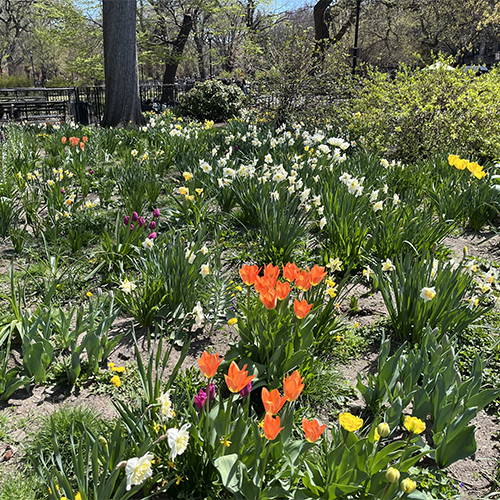
Perhaps inspired by a trip last week to the New York Botanical Garden, I’ve started to think of research as mycelium: the fine, living threads that spread beneath a forest floor, invisible at first glance but essential to everything growing above. It’s not the most glamorous part of the ecosystem. It rarely gets top billing. And yet it connects, nourishes, and makes the visible growth possible. What appears on the surface is only ever part of the story; beneath it is a dense, intelligent network quietly doing fundamental work.
Research as practice
The more time I spend at Living, the more this feels true of research here, too.
Our annual reports may be the most visible expression of it, gathering observations and insights into a form that can be shared, discussed, and built on. But the research itself doesn’t end there – it continues beneath and beyond, moving across projects and conversations, resurfacing in strategy, shaping decisions, and informing the work in quiet ways not always immediately obvious.
It’s continuous, connective, and foundational.
I half-expected the early stages of projects to look more like brainstorming in the conventional sense: quick ideas, instinctive leaps, energetic speculation. Instead, what I’ve found refreshing is the willingness to pause. To resist the urge to rush toward solutions, and instead sit with the opportunity to learn.
In our discovery phases, interviews and workshops are spent teasing out the intricacies of a client’s internal culture, assessing the strengths and strain points within existing systems, brands or digital spaces before charting the path ahead. Competitive landscapes are mapped out to identify market demands, norms and niches, giving us a sharper sense of the worlds in which we’re working. In the same way that moving across countries – both physically and in terms of academic focus – requires you to shed your ethnocentric presumptions, the more sectors and companies you work across the less you can rely on what you think you know. Internally too, colleagues have conducted their own research on sector news and industry evolutions, compiling summaries of their learnings to feed back to the team.
The result is an agency in a constant state of attention: listening, learning, and recalibrating.
That’s why our annual Ratings reports feel less like isolated bursts of research. Their insights extend far beyond publication, shaping our own work as we study how firms are thinking across brand, strategy, design, and UX. In charting that wider landscape, we not only notice what is often overlooked, but refine our own understanding of best practice. Research becomes a form of renewal: a quiet, sustaining force that keeps our work alert, reflective, and open to evolution. Like mycelium, it works quietly beneath the surface, sustaining growth long after the visible output has appeared.
The value of attention
Perhaps that’s what I find so compelling about it. Research can sound dry, procedural, even dutiful – and if my colleague Alex reads this he’ll groan that it mostly is – but in practice it feels far more alive. It’s built into our infrastructure, and integrated into our work in a way that feels vital.
As an anthropology graduate, there’s something deeply affirming in that. I placed a great deal of personal faith, emotional energy, and intellectual investment in the belief that listening and observing carry immense value – not just academically, but as ways of moving through and understanding the world. It’s the same premise that pushed me to move to London, to Tokyo, and now New York.
Beyond that, it’s affirmed the kind of career I want: one in which listening is woven into the fabric of the work, understood as a skill rather than a delay; one rooted in curiosity; and one in which continual learning is embedded in the soil of the forest floor.
Jacob Whiteley-Guest, Intern, Living New York


Our latest insights, directly to your inbox